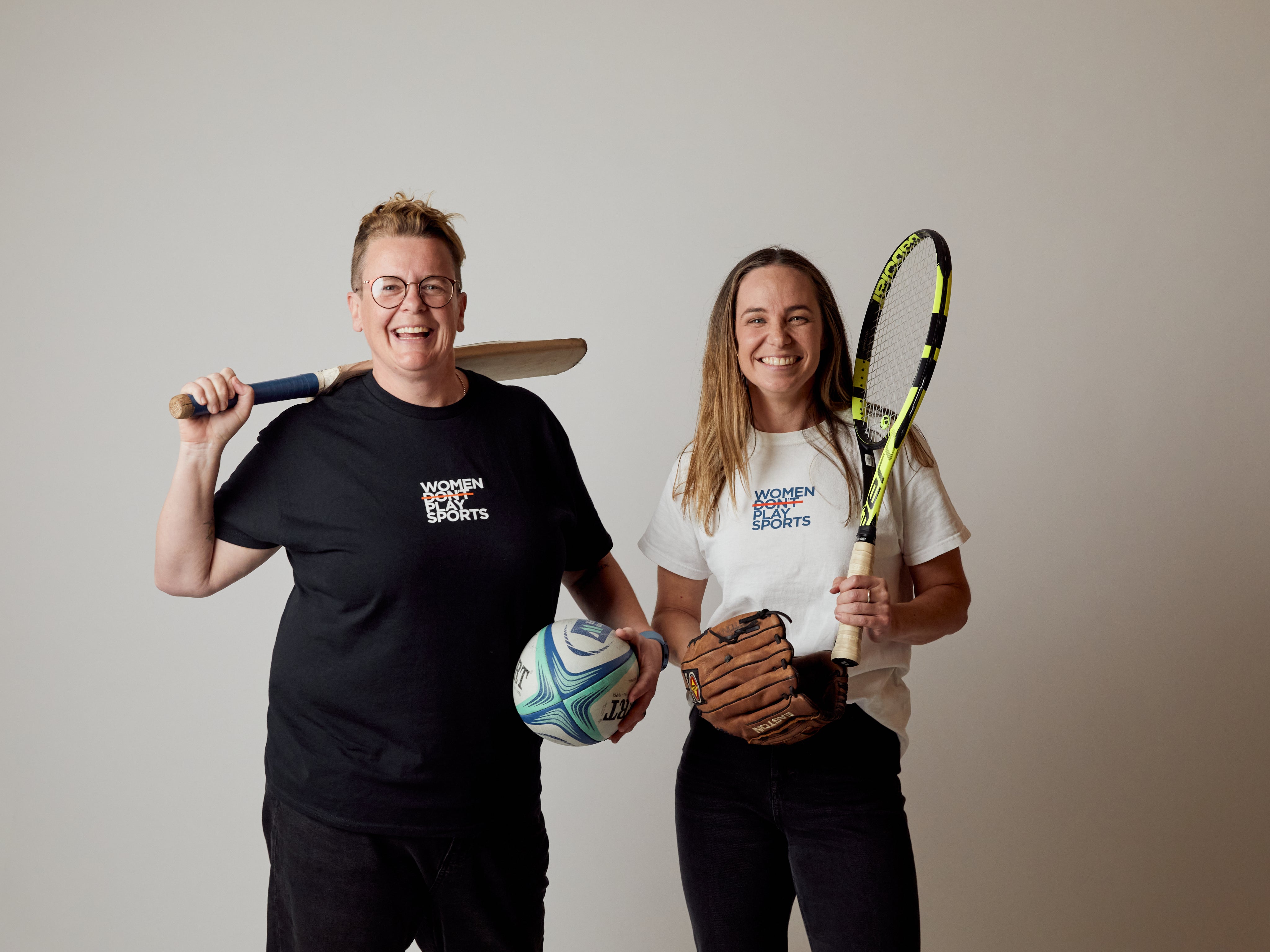

THE NEXT is a new monthly podcast from The Female Athlete Project.
Each episode, futurist and former athlete Reanna Browne joins Chloe and Bez to explore what’s changing in women’s sport, before it hits the headlines. We shine a light on the pockets of the future already here - the signals of change that are quietly [or not-so-quietly] reshaping women's sport in the present. Not to predict what’s coming, but to notice what’s already in motion.
What is Rea noticing? The Algorithm decides...
“ Algorithms are no longer tools around sport. They’re becoming an invisible infrastructure that's making decisions.”
Here are four signals [pockets of this future in the present] that Rea is noticing this month:
1. Who gets seen?
We're seeing a shift from human editors deciding what’s 'newsworthy' to machine systems deciding what’s servable.
More sports are using AI technologies to auto-create and distribute highlights in seconds.
EXAMPLE: In 2024, ESPN announced AI-generated recaps to assist 'underserved sports that journos can’t get to' specific games, including NWSL.
EXAMPLE: Even the Milano Cortina Winter Olympics used AI to generate automated highlights, tag athletes instantly, and make them searchable by natural language.
"It’s a bit like the future has to exist to be able to then police it. We don’t really know what’s going to happen, then all of a sudden it's happening and we’re like oh gosh we should put some guard rails around that." Erin [Bez] Morton
But the algorithm also misses things.
When ESPN first rolled out AI recaps for the NWSL in 2024, the system wrote a 215-word recap of Alex Morgan's final professional match and didn't mention Alex Morgan once. The name of the Two-time World Cup winner and Olympic gold medallist was completely absent until it was corrected the next morning.
"The algorithm is like a recommendation system. It will amplify content that already performs or is already there. Historically, that's men's sport."
So Vic Uni found that if a user clicks on AFL men's highlights, the algorithm serves more men's content. Over time, women's content gets squeezed out — not because it's unworthy, but because it hasn't yet built the same engagement history.
That is despite 66% of Gen Z adult females (18–24) in the UK engaging with sport (vs 79% Gen Z males), suggesting the gender gap is narrowing in the next generation.
But the algorithm is also policing women's sports content.
EXAMPLE: Women's sportswear brand XX-XY Athletics reported that TikTok banned ads featuring female athletes in sports clothing because they were 'inappropriate'.
"AI has learned what’s ‘appropriate’ from a dataset where women’s bodies were more often categorised as sexual content. So when a gymnast or a swimmer posts competition content, the system suppresses it without anyone making that decision consciously.
It’s a visibility tax that only women pay."
2. Who gets picked?
We're seeing a shift from human-based judgement in small numbers to machine-based judgement at scale.
In 2025, Seattle Reign coach Laura Harvey used ChatGPT for tactical ideas. The Result? Seattle went from second-last to fourth and made the playoffs. 15 points better than the year before.
“Coaching isn’t being replaced — it’s being augmented. And for the first time, some of these tools are being built specifically for women’s bodies."
The Artificial Intelligence tech used for injury risk is also becoming more sophisticated.
EXAMPLE: Zone7 published a Women's Super League case study across 11 teams and 423 injuries, claiming its system forecast increased risk 1–7 days prior to injury 72.4% of the time.
"If there’s an AI system that says actually, you’re more likely to get injured, the load management becomes an easier conversation for athletes to have with staff because there’s actually numbers behind it" - Erin [Bez] Morton
But it's not just professional athletes who are impacted by AI. It impacts those who aspire to be professional athletes too.
EXAMPLE: Rebekah Pierce, from the small British Island of Jersey, downloaded Chelsea's aiScout app, filmed drills on her phone, and uploaded the video. AI reviewed her skills and went to Chelsea’s recruitment team. She ended up in the Chelsea FC Women’s U18 squad. Something impossible without the app.
"In this particular instance, AI is allowing pathways and exposure to more people. It’s a tool for democratisation for people in the bush."
3. Who get$ paid?
"Increasingly part of the job of being an athlete is that you need to be online, and that’s both a blessing and a curse "
The line between playing sports and performing online has almost disappeared. It raises the question: Is your value determined by what you do on the field or is it now determined by the algorithm?
Regardless, women are doing the engagement work while men capture the revenue.
SponsorUnited reported women's posts engage followers at nearly 8x the rate of men's posts. But according to the Washington Post, at 12 schools men out earned women $92 million to $19 million.
"If algorithms reward engagement, but pay structures reward tradition and legacy, what exactly is women’s sport being asked to do?"
One way that sportswomen may actually benefit from the use of AI is through digital agents. Athletes are increasingly replacing human agents with AI tools like ChatGPT to negotiate contracts.
EXAMPLE: Former Man United youth prospect Demetri Mitchell claimed he used AI platform ChatGPT when negotiating his move to League One side Leyton Orient, saying that the software has been his 'best agent to date.'
But does using the algorithm now mean you don't have to be the best athlete in the league to earn the most money?
Brands now use algorithms to find the athlete who has the strongest emotional bond with their fans, even if that athlete never leaves the bench. These AI tools don't just count your followers. They scan your comments to see sentiment on engagement. This is called your Parasocial Value.
EXAMPLE: Ilona Maher isn't the most-capped or the most decorated player in the U.S Women's Rugby system, but she's certainly the most marketable, most-followed and likely the highest-paid of her teammates. That's due to the partnerships she's created with Paula’s Choice Skincare, L'Oréal Paris and Adidas, as a result of her content.
4. Who gets protected?
“Women’s sport is scaling visibility. But visibility is also targetability, and the tools to harass, sexualise, and intimidate are becoming cheaper and faster.”
Research from Deakin University shows 87% of women athletes experienced gendered online harm in the past year.
The eSafety Commissioner also cited that pornographic videos make up 98% of deepfake material online, and 99% of that imagery depicts women and girls, alongside steep growth in explicit deepfakes.
But now we're seeing a shift from online abuse being treated as an individual problem to abuse being treated as a systems problem that requires AI tooling, operational response, and regulation.
Sports organisations are starting to run tech-style safety operations because the abuse volume is beyond human scale.
EXAMPLES: Wimbledon deployed AI [Threat Matrix] to detect and flag abusive content across languages, supporting security responses and escalation. Meanwhile, UK Sport has launched Social Protect — an AI tool to hide abusive comments for thousands of Olympic and Paralympic athletes through LA 2028.
BUT these interventions are often NOT gender-specific and do not match the experience of women.
“A lot of these interventions are not gender-specific considering the majority of harm is experienced by women. The algorithm that writes these things should be gender-specific, given the disproportionate nature of the harm for women." - Rea Browne
So what, now what?
The algorithm isn’t the villain. But it isn’t neutral either. Algorithms are designed.
"Women’s sport doesn’t need to reject AI and algorithms. It needs to set the rules of the machine, because the machine is already shaping the game. Every click trains the algorithm. Search for women’s sport. Click on it. Share it. Subscribe. You are the training data."
What is the future of women’s sports we want to inhabit? What stories and content do we want to see more of and less of?

Leave a comment